

A fiberglass pool can take up a very different amount of a backyard depending on its shape, depth, steps, tanning ledge, seating, and surrounding deck. That’s particularly important around St. Louis, where properties can range from relatively level suburban lots to backyards with slopes, drainage concerns, and tighter access.
At Excel Landscaping, we install Latham inground fiberglass pools throughout the St. Louis area. Latham gives us a broad selection of established pool shapes and models to work with, while our role is to determine how the pool and the rest of the project fit the individual property.
So rather than going through the entire Latham catalog, we’ve selected seven model options that illustrate the differences homeowners are likely to encounter. Some prioritize open swimming space. Others dedicate more room to tanning ledges, seating, deeper water, or an integrated spa.

Our Recommended Latham Fiberglass Pool Models for St. Louis Homes
When comparing Latham fiberglass pools, we recommend looking beyond the overall shape. Tanning ledges, steps, seating, depth, and open swimming space can make pools with similar dimensions feel very different.
The models below are some of the options we recommend considering based on your available space, preferred layout, and the features you want in the pool.
Looking at Latham’s fiberglass pool collections individually makes those differences easier to compare, starting with the Corinthian Collection.
1. Latham Corinthian Collection
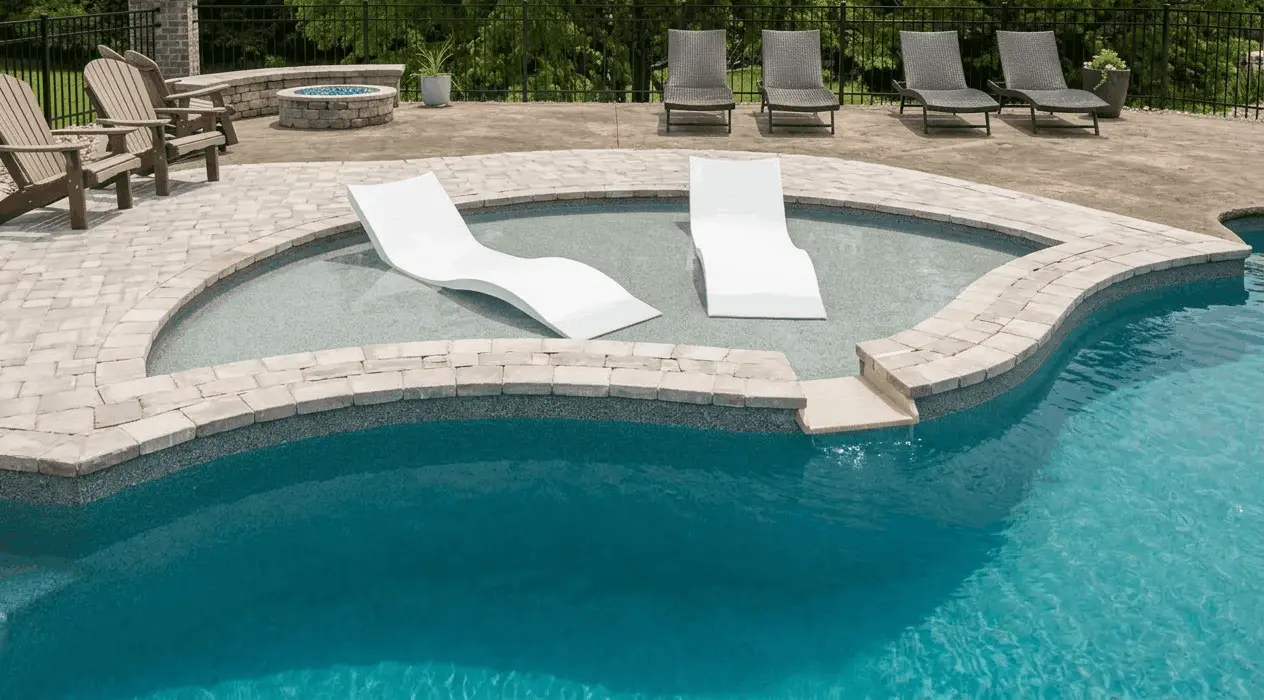
The Corinthian is a rectangular fiberglass pool with a tanning ledge at one end and open swimming space beyond it.
Latham offers the collection in several dimensions. The Corinthian 12 measures 12′ × 25′, while the Corinthian 14 measures 14′ × 30′.
Corinthian Features
- Rectangular shape
- Built-in tanning ledge
- Swim-up seating
- Multiple sizes available
- Automatic-cover compatibility
The Corinthian 12 shows how a tanning ledge can be incorporated without moving into a particularly long pool. Its 12′ × 25′ footprint is considerably different from some of the 35- and 40-foot pools we’ll get to below.
Move up to the Corinthian 14 and you gain another two feet of width and five feet of length.
That additional space is noticeable in the water, but it’s also noticeable outside it. Once a deck is added around the pool, the difference between a 25-foot and 30-foot shell becomes more significant than the dimensions alone might suggest.
2. Latham Astoria Collection
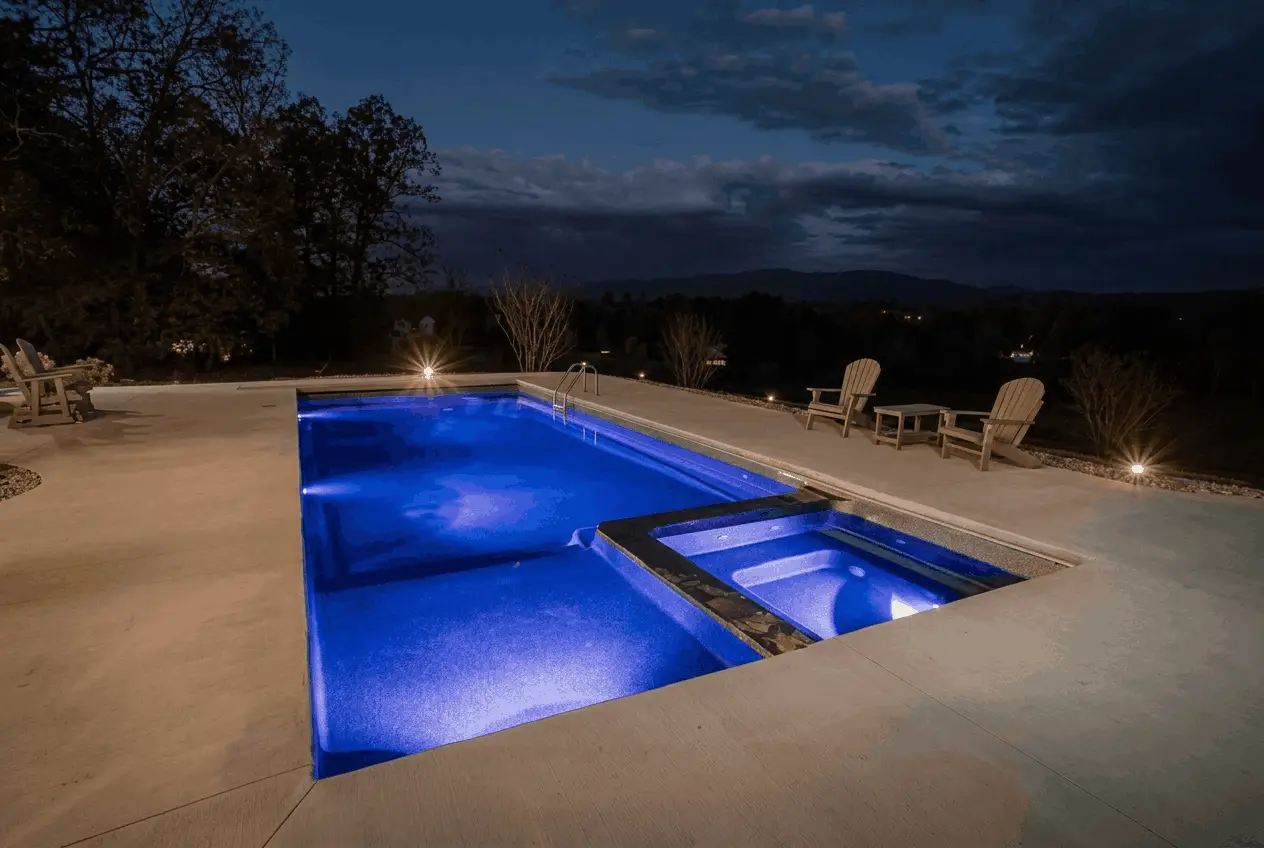
The Astoria changes the layout by bringing another feature directly into the fiberglass shell: a spa.
Instead of locating a separate spa somewhere around the pool deck, the Astoria combines the swimming area, tanning ledge, seating, and spa within one design.
Latham offers several sizes:
| Model | Dimensions | Pool Depth |
|---|---|---|
| Astoria 12 | 12′ × 28′ | 3’–5’7″ |
| Astoria 14 | 14′ × 35′ | 3’6″–6’6″ |
| Astoria 16 | 15’10” × 40′ | 3’6″–7′ |
The Astoria 12 is particularly interesting from a space-planning perspective. The pool, tanning ledge, and spa are contained within a 12′ × 28′ shell.
The Astoria 16 uses the same general concept on a much larger scale. At nearly 16 feet wide and 40 feet long, it also reaches a 7-foot depth.
If the integrated spa is what initially catches your attention, look at what surrounds it as well. The three Astoria sizes differ substantially in swimming area, depth, and total footprint.
3. Latham Apollo 14
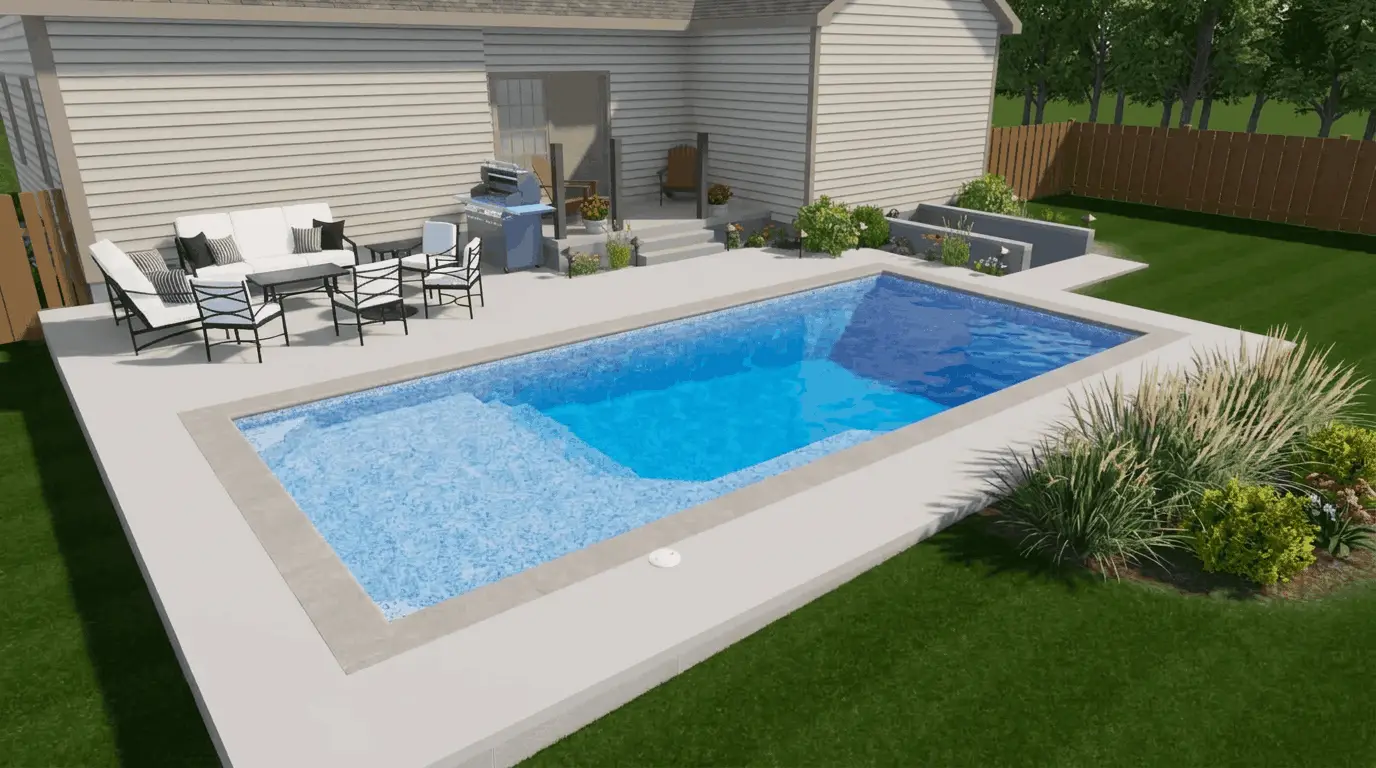
The Apollo 14 measures 13’10” × 32′, with depths ranging from 3’6″ to 6’1″.
It retains a straightforward rectangular perimeter while incorporating a tanning ledge, swim-up seating, and several points for entering and leaving the water.
Apollo 14 Features
- 13’10” × 32′
- 3’6″–6’1″ depth
- Tanning ledge
- Swim-up seating
- Multiple entry and exit points
- Automatic-cover compatibility
Its 32-foot length places the Apollo between some of Latham’s smaller fiberglass pools and the larger models approaching 40 feet.
That’s a useful size to see when comparing pools on paper. A 25-foot, 32-foot, and 40-foot pool may all look fairly similar in separate photographs. Put their outlines on the same property plan and the differences become much clearer.
4. Latham Ariel 16
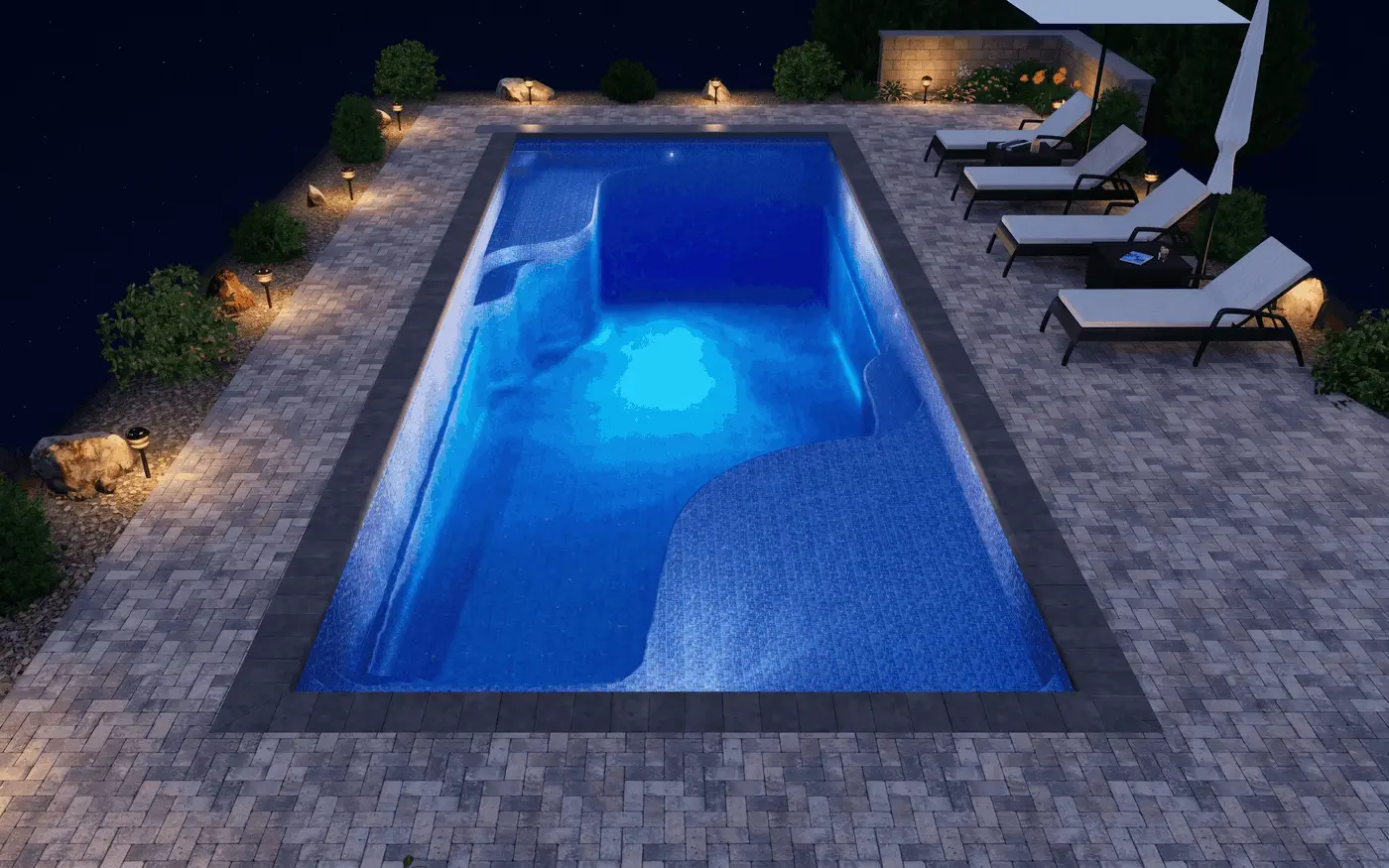
The Ariel 16 measures 15’10” × 40′ and transitions from 3’6″ to 7’4″ deep.
The depth immediately separates it from several of the other fiberglass pool models in this guide.
The design also incorporates tanning ledges, swim-up seating, and multiple entry and exit points.
Ariel 16 Features
- 15’10” × 40′
- 3’6″–7’4″ depth
- Tanning ledges
- Swim-up seating
- Multiple entry and exit points
- Automatic-cover compatibility
The 40-foot length is equally important.
A manufacturer’s photograph has plenty of room to frame the pool. A backyard has property lines, a house, deck space, equipment, landscaping, and possibly a slope to contend with.
If you’re drawn toward a larger fiberglass model such as the Ariel, it helps to mark out the actual dimensions in the yard. Forty feet feels different when you’re standing beside it.
5. Latham Cayman 16

The Cayman 16 measures 15’10” × 38′, with depths ranging from 3’6″ to 6’8″.
Its tanning ledge is one of the most noticeable elements of the layout. Rather than treating the entire 38-foot shell as open swimming area, part of the pool becomes a dedicated shallow-water space.
Cayman 16 Features
- 15’10” × 38′
- 3’6″–6’8″ depth
- Large tanning ledge
- Integrated seating
- Rectangular shape
This is a good example of why comparing pools solely by their outside dimensions doesn’t tell the whole story.
Two fiberglass pools could both be approximately 16′ × 38′, yet the experience inside them can be very different depending on how much space is occupied by ledges, steps, and seating.
A large tanning ledge gives you somewhere to place in-water loungers or sit in shallow water. The tradeoff is simply that the same square footage isn’t being used as open swimming space.
Neither approach is inherently better. They’re two different ways to use the same backyard footprint.
6. Latham Unity
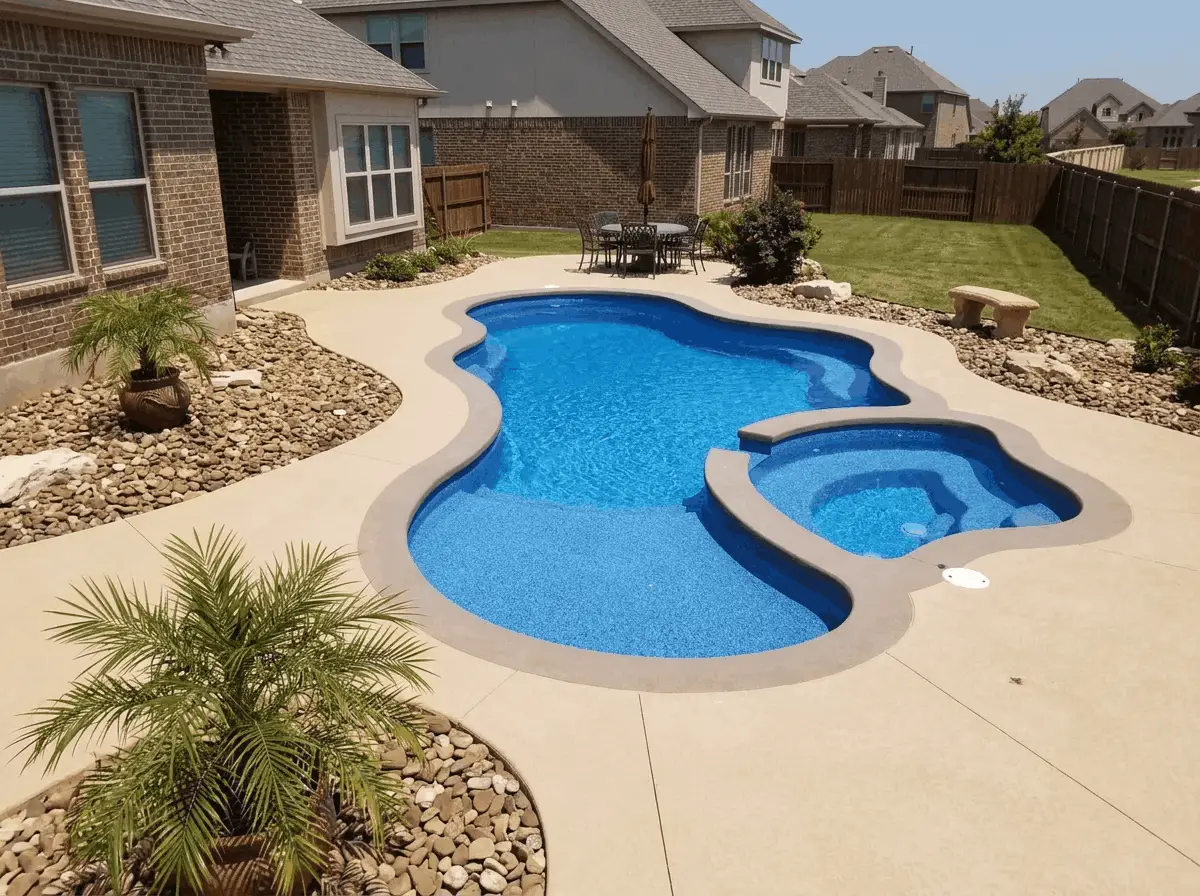
Most of the models above share one obvious characteristic: straight lines.
The Latham Unity takes a different approach.
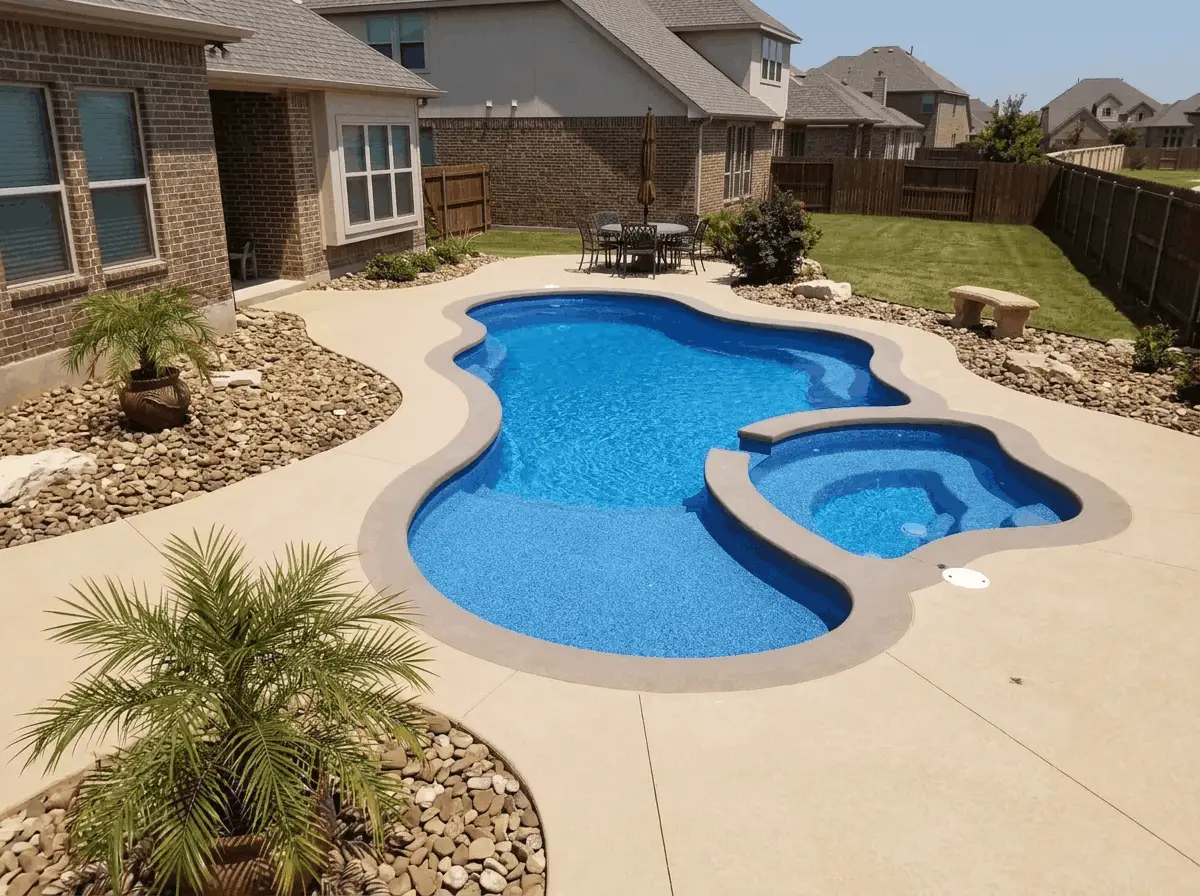
It measures 16′ × 35′, with depths ranging from 3’6″ to 6’6″, but uses a freeform perimeter rather than a traditional rectangle.
Unity Features
- 16′ × 35′
- 3’6″–6’6″ depth
- Freeform shape
- Curved perimeter
- Swim-up seating
Those curves affect more than the appearance of the pool.
With a rectangular pool, the surrounding deck naturally follows fairly predictable lines. A freeform shell creates pockets and curves that can be handled differently with decking, planting beds, or other landscaping.
If you’re deciding between rectangular and freeform pools, don’t picture only the water. Picture the shape of the space that will remain around it.
7. Latham Classic Collection
Not every pool needs an integrated spa, large tanning ledge, or multiple built-in lounging areas.
Latham’s Classic Collection includes several more straightforward rectangular designs, with dimensions ranging from relatively compact pools to substantially larger shells.
For example:
| Model | Dimensions | General Size |
|---|---|---|
| Delray | 11’10” × 25’5″ | Compact |
| Claremont | 14′ × 33′ | Mid-sized |
| Kingston | 16′ × 38′ | Large |
The Delray also stands apart because it maintains a 4’6″ depth instead of transitioning into a significantly deeper end.
That changes how the water can be used.
In a consistent-depth pool, a larger portion remains at standing depth. A pool that transitions beyond six or seven feet creates a distinctly different shallow and deep end.
Tanning Ledge or More Open Water?
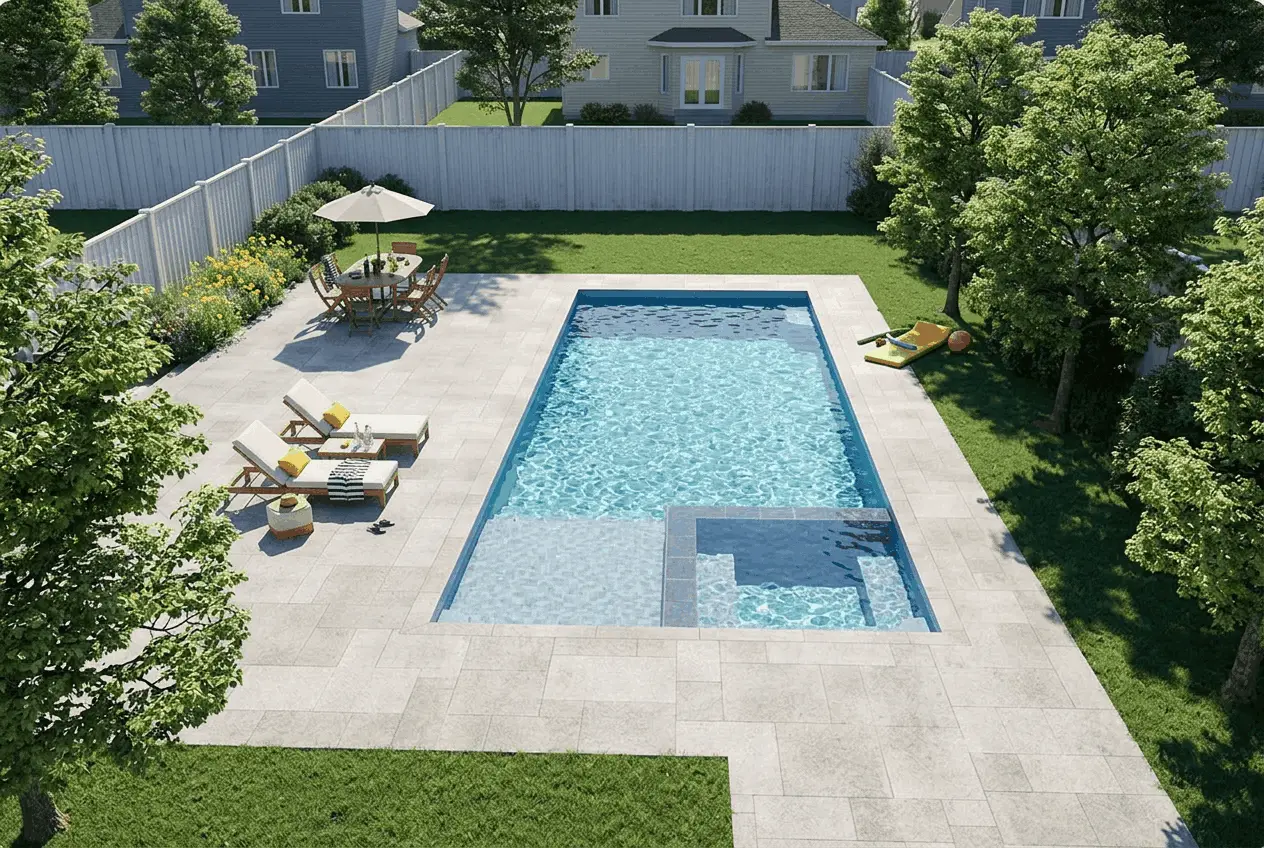
Tanning ledges appear throughout the Latham fiberglass pool lineup, including the Corinthian, Apollo, Ariel, Astoria, and Cayman designs.
They’re shallow platforms built directly into the pool and can accommodate in-water loungers or simply provide somewhere to sit partially submerged.
What photographs don’t always communicate is how much of the shell the ledge occupies.
Take two pools of similar length. One may devote a significant section to a tanning ledge while another leaves that same area open for swimming.
If you picture yourself sitting in shallow water or using loungers frequently, you’ll probably pay more attention to the ledge. If you picture kids swimming from one end to the other, the amount of uninterrupted water may stand out more.
An overhead drawing of the pool can often tell you more than the finished photograph.
How to Compare Fiberglass Pool Models Without Overcomplicating It
You don’t need to work through the entire Latham catalog one model at a time.
Start with the physical limitations of the property. Anything clearly too large can come off the list.
Then compare the characteristics that actually change how the pool fits your property and how the space comes together:
- Overall dimensions to determine how much backyard space the pool will occupy
- Pool shape to choose between a rectangular or freeform layout
- Depth to compare consistent depths with designs that transition into deeper water
- Tanning ledge to decide between dedicated shallow space and more open swimming area
- Spa configuration to consider an integrated spa or a separate setup
- Steps and seating to see how these features affect usable swimming space
- Surrounding space to leave enough room for decking, furniture, landscaping, and comfortable circulation