
Installing a Large Unilock Paver Patio in Valley Park
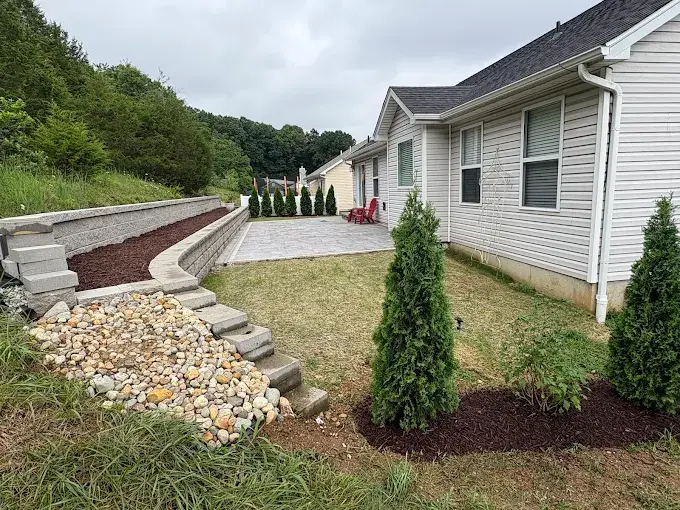
This paver patio installation in Valley Park replaced a small concrete slab off the back door. We broke out the old concrete, built a large Unilock paver patio on a compacted gravel base, and finished it with polymeric sand joints and a soldier course border. Arborvitae and new mulched beds round out the backyard.
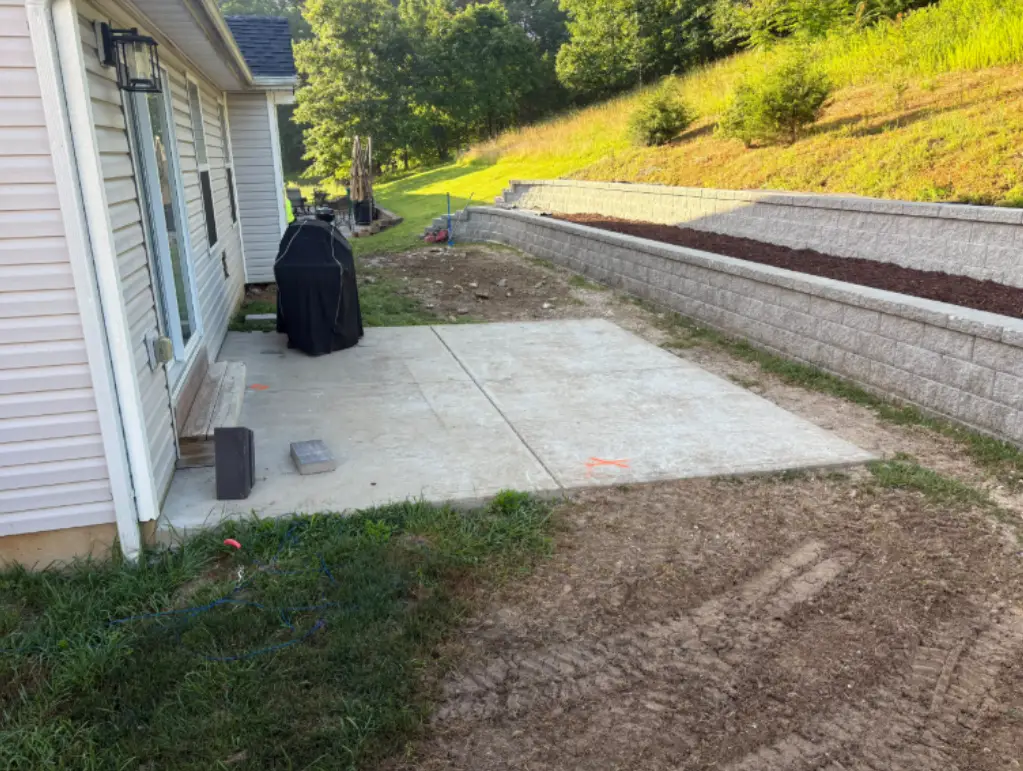
A Small Concrete Slab Behind the House
The backyard of this Valley Park home runs between the house and a block retaining wall at the foot of a grassy hillside. The patio was an old concrete slab off the back door, only two panels wide. With the grill parked on it, there wasn’t much room left for chairs or company.
The homeowners wanted a real patio with room to spread out, plus more privacy at the ends of the yard. That meant starting over instead of adding on to the old slab.
Breaking Out the Old Concrete Patio
The old slab came out completely. We broke up the concrete and hauled it away, which cleared the ground for a much larger patio. Starting from bare ground also meant the new base could go in the same way under every part of the patio, with no old concrete left underneath any of it.
Building the Paver Patio on a Compacted Gravel Base
Every Unilock paver patio installation we do starts with the base. Here, that’s compacted gravel under the full footprint of the patio. The base is what keeps pavers flat and tight through St. Louis freeze-thaw winters, so it’s the part we take the most care with.
On top of the base, we laid Unilock pavers [CONFIRM: product and color] across a patio far larger than the old slab. It now runs from the back door out past the end of the house, with plenty of room for chairs and the grill.
Polymeric Sand Joints and a Soldier Course Border
Polymeric sand fills the joints. Once it’s wet down it hardens, which helps keep weeds and ants out of the joints. A soldier course border, a row of pavers set lengthwise around the edge, frames the patio and holds the field pavers in place.
Arborvitae for Privacy and Mulched Beds Along the House
With the patio in, we planted arborvitae at the ends of the yard. They’re narrow, upright evergreens that will grow into a green privacy screen. Along the house, we mulched new beds and set an arborvitae at each corner.
The completed project included:
- Break-out and haul-away of the old concrete patio
- A compacted gravel base under the full new patio
- A large Unilock paver patio with polymeric sand joints
- A soldier course border around the patio edge
- Arborvitae at the ends of the yard for privacy
- Mulched beds along the house, with an arborvitae at each corner
A Backyard Patio With Room to Spread Out
The old two-panel slab is gone. In its place, a large Unilock patio stretches across the backyard of this Valley Park home, with room for chairs, the grill and company. As the arborvitae grow, they’ll fill in a privacy screen at the ends of the yard.
Also in Valley Park, we took the other approach for another family: we kept their concrete and extended a small patio with pavers. Which one fits depends on the shape your concrete is in and how much room you need.
Is Your Concrete Patio Too Small or Worn Out?
If your patio only fits the grill, or the concrete is cracked, sinking or stained, it may be time to look at pavers. A paver patio can be laid out bigger than the slab it replaces, and pavers can be lifted and reset if the ground ever settles. For homes in Valley Park and the St. Louis County towns we serve, we’ll measure it with you.